The History of a Melody.

© David Kidd
"Oh, my name is Captain Kidd, as I sailed, as I sailed..."
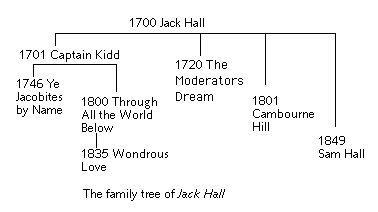
We all know that old tune Captain Kidd — or do we? If a group sings it out loud, we find everyone sings it to a slightly different tune. Many historians say the tune should be like Ye Jacobites by Name, a sung by Owen Hand, but perhaps it more resembles Sam Hall as sung by "Winkle" Winkler?
Musicologist Bruce Olson commented, "Exactly what tune was known as Captain Kidd in the 18th century has been a little fuzzy, as the tune was never known to have been printed under that title, and even circumstantial evidence is rather meagre”
So, which is the correct tune for this song? All we can be sure of is that it came from before Kidd's execution in 1701.
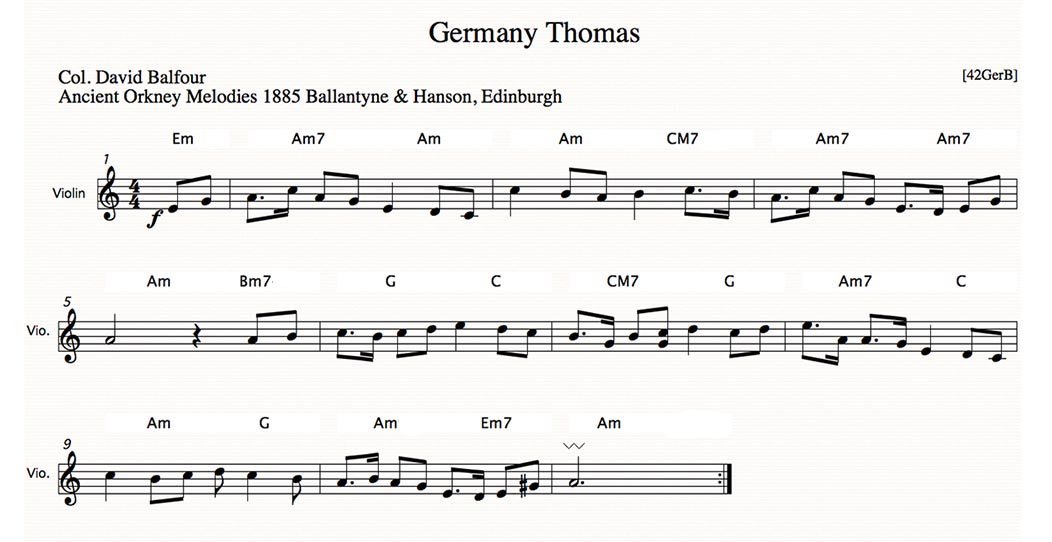
There is, however, an earlier printed lyric in the same meter: “All My Lufe, Leif Me Not, Leif Me Not.” This appeared in a Scottish book of sacred songs of 1567, the Wedderburn brothers' ‘Gude and Godlie Ballates’. However, no score was printed included. Historians Gilchrist* and White† agree that the song iLeif Me Not… is a sacred parody of a secular folk song “My lufe is lyand sick, send him joy, send him joy” listed in the ‘Complaynt of Scotland’ of 1549; unfortunately, we have, once more, only the first line. Gilchrist conjectured that the music for these two songs could be the tune later printed for Germany Thomas, speculating that although that song's lyrics refer to the war of 1630-48, the tune could be older.
*Gilchrist, A.G. Journal of the English Folk Dance and Song Society, vol. III, no. 3, 1938, pp. 157-182.
†White, E.A. Journal of English Folk Dance and Song. Vol IV (i) 1940, pp. 23- 30.
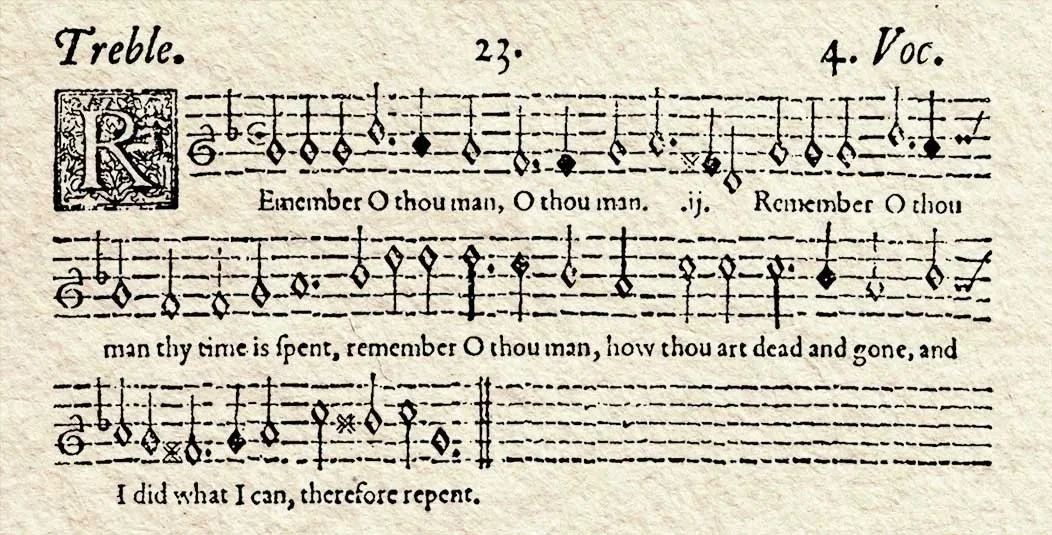
Melismata, Musical Phantasies, Fitting the Court, City and Country Hymnus, To 3, 4, and 5 Voices by Thomas Ravencroft. London 1611. [11CaOm]
1. Remember O Thou Man
The earliest printed score that resembles Captain Kidd in both tune and metre, is a Christmas Carol of 1611 in Thomas Ravencroft’s Melismata, however, it differs from later examples by being in three-four time
2. Celtic Roots
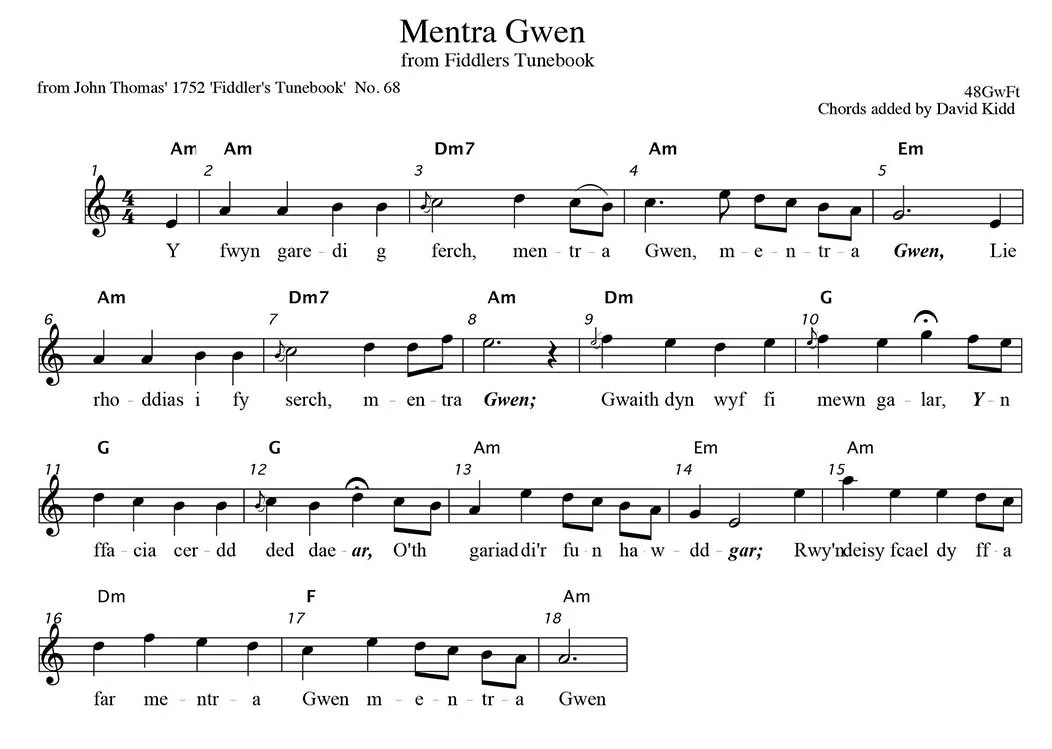
This is but one of four variations we have found.
“In the song Captain Kidd, students of folk song now recognise the pattern of a well-defined old Welsh ballad "Mentra Gwen” ~Bonner, 1947.
Another possible Celtic root is Mentra Gwen, neu Cwynfau y Wraig Weddw (Venture Gwen, or the Plaint of the Widow). In Wales, that is sung to more than two tunes, suggesting that Mentra Gwen may refer more to a rhyming structure and meter than to a single, fixed song. While the tunes are similar to Captain Kidd, it is difficult to establish the lineage or precise age of Mentra Gwen, as it was not mentioned in print until 1717, then by Richard Moms.
3. Scottish Lowlands
White writes, “There is no Scottish song between the parody of 1567 and the song Germanie Thomas printed in 1794. However, it seems certain that some such song, widely known, had existed throughout the period.”
Furthermore, notes on the Jacobite songs in Hogg’s Jacobite Relics and on 'Germanie' in some Scottish Collections note that similar songs to the same tune were common in the Scottish Lowlands. This continuity suggests that a Scottish love lyric existed uninterrupted from the middle of the sixteenth century. Like many folk songs, it was brought up to date from time to time. The earliest form, that in the Complaynt of Scotland, may have referred to Scots who had gone abroad to serve under the Kings of France (see Forbes-Leith, Muster Roll of Scots Guard). Later, the lyrics may have been adapted to refer to the Scots who fought in the Thirty Years’ War in Germany, and subsequently those who fought in the French Wars of the eighteenth century.
4. The Diggers Song
E.A. White suggests ”The Scottish song, or some song derived from it , was picked up by English soldiers during the Civil Wars [1642-51] and so suggested the form, first of the Diggers’ song
and then fifty years later of the ballads Jack Hall and Captain Kidd. This last was long remembered… I suggest that the “Diggers’ Song” is the known link—there may have been others—connecting the English songs with the Scottish prototype.”
However, this is conjecture, for unfortunately no music was ever printed for folk songs in the olden days; hence, no historical documents can be found to prove his proposal.
The site of the Diggers 1649 event was St. George’s Hill, Weybridge, Surrey. The modern local authorities voted that the Diggers’ Song should be sung to a version of Captain Kidd.
However, there is a different tune for Diggers composed by Leon Rosselson.
5. Farewell
The opening bars of “London's Farewell to Parliament” have the structure we seek but then it drifts off away from our tune.
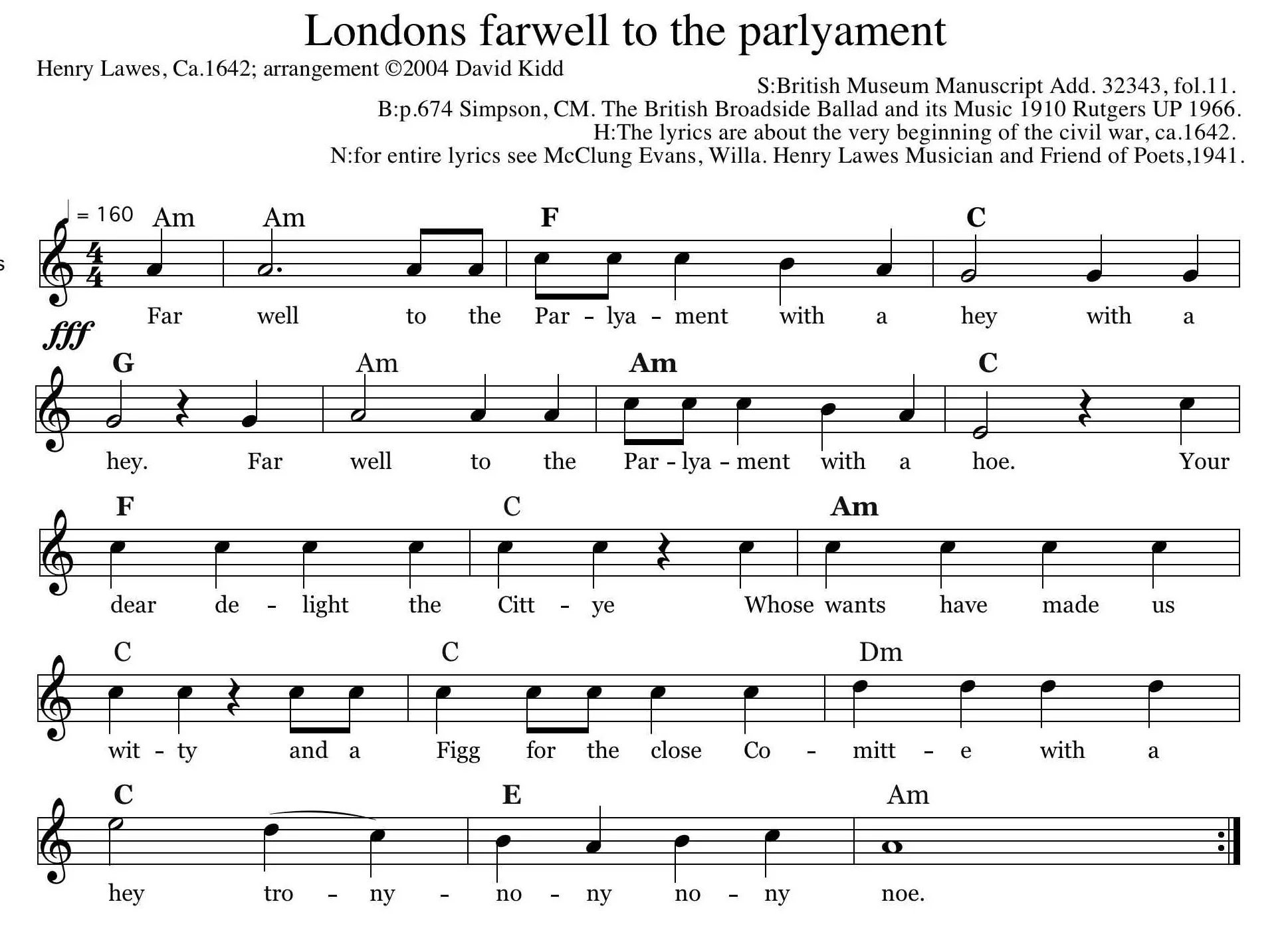
Farwell to ye parlyament, with a Hey with a Hey,
Farwell to ye parliament with a Hoe,
Your dear delight ye Cittye, whose wants have made us witty
And a figg for ye close Comittee, with a Hey tronony nony Hoe.
6. Sound a Charge
Another group of songs that do more closely resemble Kidd, cite "Sound a Charge" as their tune. The first appearance of which in print was in 1654: "A Spiritual Song touching doing away of Sin," in the book titled A Small Mite
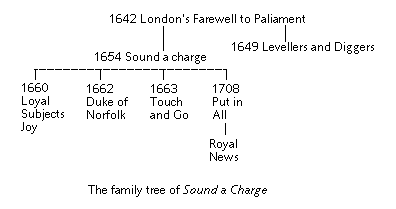
This tune reappeared in 1662 for "The Beggar laid him down to sleep" and the satrical "Duke of Norfolk"
"I am the Duke of Norfolk with a Hey with a Hey,
I am the Duke of Norfolk with a Hoe....
I am the Duke of Norfolk with a Hey tronony nony floe.
7. Purge Melancholy
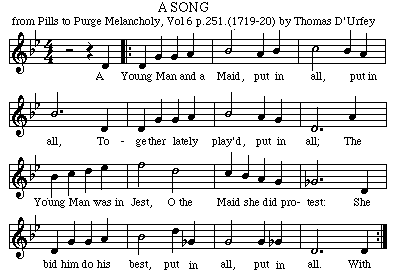
The tune "Sound a Charge" is also cited for Put in All in 24 country Dances for the Year 1708 by John Young, and in his Dancing Master, or Directions for Country Dancing 1710.
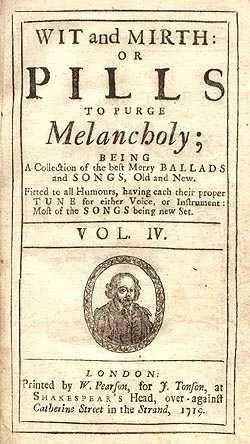
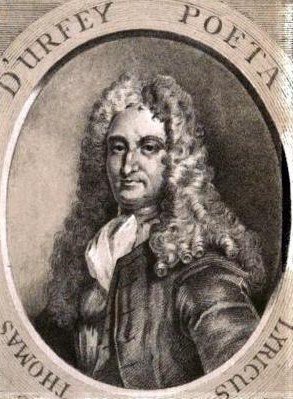
However, the dance tune "Put in All" became better known by a risque parody published in 1719 in Thomas D’Urfey in his Pills to Purge Melancholy.
8. Documented Descent
At last, there are real documents connecting the following songs with Captain Kidd